

Text and spectacle in Somalia | Governance study group
Fri, 2026-07-24

Sharing our experimental call summaries.
Al-generated digests of Yak Collective study groups.
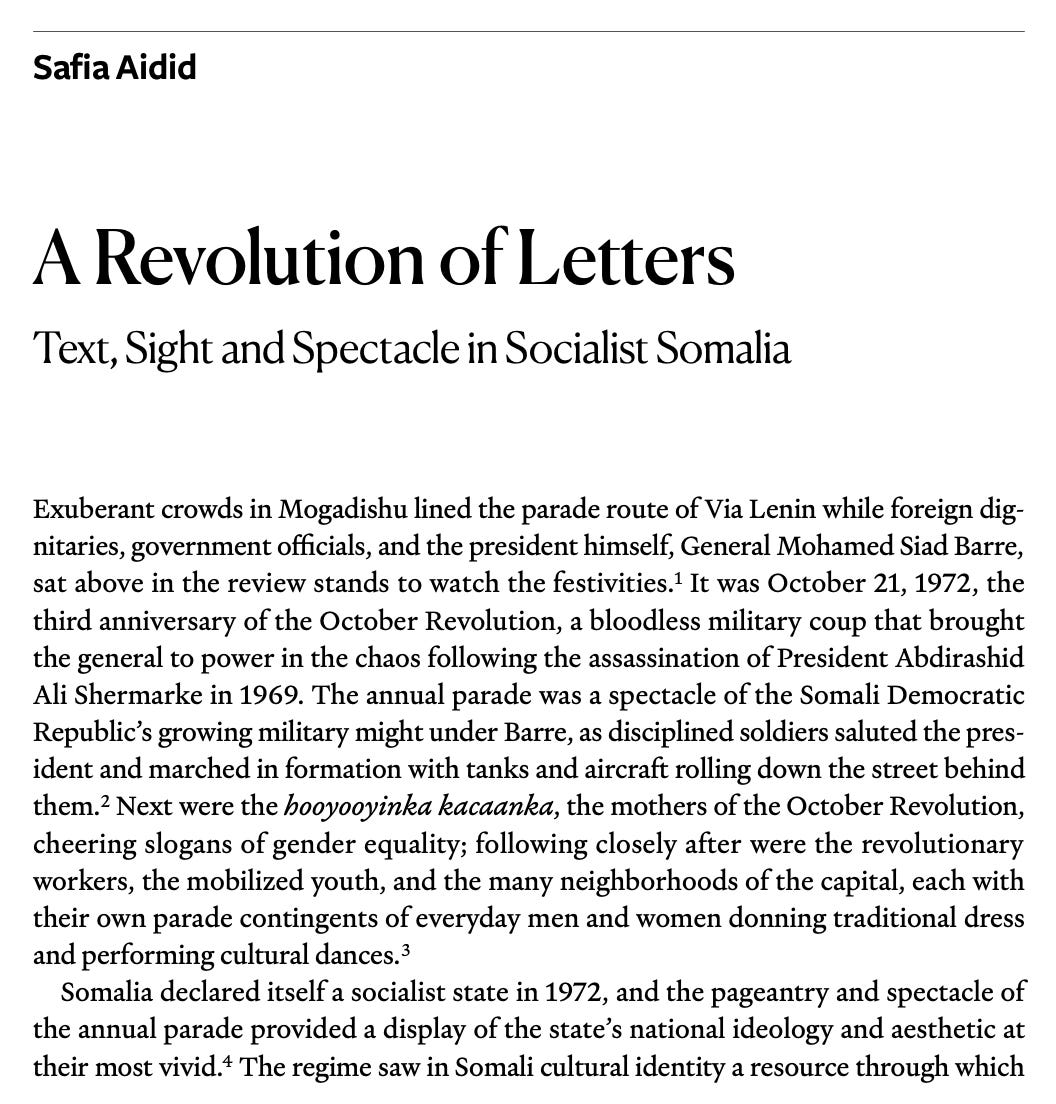
Safia Aidid, A Revolution of Letters: Text, Sight and Spectacle in Socialist Somalia, The American Historical Review, 2025. https://doi.org/10.1093/ahr/rhaf404
Article Context
Central argument: The Somali script is a remarkably recent national project, standardized post-independence under a socialist military government, making it a rare case of a post-print, multimedia language standardization effort.
Key provocations:
Italian printers refused to typeset an earlier invented Somali script, demonstrating how control of print infrastructure materially constrains language politics
The regime ultimately chose the script that fit available typewriters, not the most linguistically sophisticated option
Radio and oral poetry functioned as mass-spectacle vehicles for spreading the new written language
Women played a significant role in the literacy campaign
Governance themes engaged: high modernist legibility projects, technology as de facto standard-setter, the relationship between socialist ideology and language fetishization, post-colonial nation-building
Individual Synthesis Patterns
Ellen
Lens: Language as cultural identity, Canadian bilingualism as comparative case
Key connections:
Quebec air traffic controllers suspended in the mid-1970s for speaking French on the job; public outrage eventually extended bilingualism policy into operational protocols
This sparked separatist gains in the 1976 Quebec election
Trudeau Sr.’s bilingualism policy as the inverse of Somalia’s unification project: managing linguistic plurality rather than imposing unity
Interpretive move: Noted that both French and English in Canada are colonial languages; the “authentic” alternative would require learning Anishinaabeg, Haudenosaunee, Cree, etc., which are still largely absent from public education
Specific observation: CBC occasionally features indigenous-language Olympic commentary, which she found notable precisely because it remains exceptional
Andre
Lens: Language as a permeability membrane, degree of openness to outside languages as a governance choice
Key connections:
Ataturk’s 1920s pivot to the Latin alphabet as a deliberate westward orientation, framed as relatively “baggage-free” because Turkey was never colonized
French-Canadian social norm of switching to English when one English speaker enters a room: “after fifty years of my uncle being married to my aunt, it feels like maybe that wasn’t the right way to go”
Interpretive move: Framed script choice as building a “double layer of defense,” where adopting a unique script compounds the barrier to cross-linguistic mobility
Flagged assumption: His prior image of Somalia was shaped by “Black Hawk Down,” making the sophistication of the typeface debate surprising
Venkat
Lens: Computational/evolutionary model of language; post-print dynamics as a distinct regime from pre-print
Key distinctions:
Pre-print script adoption: low-capex, decentralized (quill, stone carving), driven by elite political power but hard to centrally cap
Post-print script adoption: high-capex, centralized (printing presses require specialist construction and capital), enabling authoritarian language installation
The Italian printers’ refusal as a concrete illustration of how control of production infrastructure blocks language projects
Novel connections:
Persian script’s historical reach across North India explains why Urdu retains it while Hindi uses Devanagari, despite mutual intelligibility
Indonesian shifted from a Sanskrit-based script to Latin; Thai preserves an ancient Tamil-derived fork
Europe’s geography is hostile to large empires, which is why Latin script spread only via the Roman exception; Cyrillic didn’t percolate far beyond Eastern Europe
Central argument: English’s openness (he called it “open source”) explains its vocabulary dominance. English has roughly double the vocabulary of peer languages. French and German loan words from English are modern; English loan words from French are premodern. In Hindi, the effect is more extreme: “you literally can think 10x more expressively in English than in Hindi because Hindi is basically frozen at early modern level.”
Interpretive move: Reframed the whole discourse as a category error. Language is “software,” not just political representation. Postmodern Marxist critique of print hegemony misses that ossification at one layer enables generative evolution at the next. Controlling language kills it; leaving it open produces winner-take-all dynamics.
Self-caught tension: Acknowledged that open competition produces winners, so you “can’t have it both ways.” Leaving language open to generativity also leaves it open to English dominance.
Practical conclusion: “If I were Somalian today, I would probably be very practical and say, screw this. I’m gonna learn enough Somalian reading and writing to get by. I’m going to focus all my personal educational goals in English.”
Kiran
Lens: Creolization as the organic, bottom-up counterpart to high modernist imposition
Key connections:
A linguistic history of India written by a Jamaican author who experienced creolization firsthand
Jamaican creole: slave women retained fragments of West African grammar (substratum) while vocabulary came from the father tongue, producing a hybrid that wasn’t a clean parent-child language relationship
Bangalore’s Kannada-Hindi-English mix as a living creole that emerged in the last 20 years through tech-driven migration and schooling
Comparative governance case: Urdu imposed on East Pakistan contributed to state breakup. Nehru’s decision not to impose Hindi and instead allow regional languages their own states produced a more stable, if slower, integration. Current Hindu nationalist pressure to impose Hindi echoes the earlier failure mode.
Interpretive move: Creolization as the “muddling version” of the high modernist script imposition, not its opposite but its organic analog
Sachin
Lens: Language, spectacle, and the visual culture of national projects; archival precarity
Entry point: Discovered the article while reading about efforts to archive Radio Mogadishu; much of the revolutionary-era audio is unarchived or disappearing after decades of civil war
Key observation: Radio and oral poetry function as fast, wide-reach information channels in Somalia, which connects the script project to mass spectacle
Novel framework: Pre-print spectacle was participatory; you were inside it. Post-print spectacle introduced distance, the observer watching rather than participating. McLuhan’s Gutenberg Galaxy: print made visual information dominant. The Somali case shows language spreading through mass spectacle.
Further distinction: National projects that emerged after print became cheap (mass paperbacks, magazines, posters) have a different visual culture than earlier ones. Kerala as example: early communist movements used magazines and print culture to construct a Kerala identity; political campaigns saturate everyday life visually in a way that feels different from the US.
Socialism and language fetishization: Post-Marx national projects, even authoritarian ones, tend to fetishize literacy. Kerala’s town-square newspaper huts as a physical manifestation. Books treated as objects of cultural value.
Gender observation: Women’s participation in public nation-building moments advanced faster than women’s personal rights in these socialist-inflected projects. “A different form of high modernist legibility in women’s rights.”
Points of Convergence and Tension
Convergence:
All participants recognized the Somali case as an instance of high modernist legibility, regardless of whether the framing was socialist or capitalist
Multiple participants independently reached for the Turkey/Ataturk example as a comparative case
Technology availability as de facto standard-setter: the typewriter point resonated across several contributions (Ellen on protocols, Venkat on capex dynamics)
Socialism’s relationship to language fetishization noted independently by Sachin and Kiran
Tensions:
Venkat’s computational/evolutionary framing sits in tension with the political framing most others used. Where others analyzed language politics as meaningful governance choices, Venkat argued the politics are “almost besides the point” because language is software subject to competitive dynamics that override political intention. This is an empirical disagreement about scope conditions, not just a definitional one.
Kiran’s creolization lens implicitly challenges Venkat’s winner-take-all conclusion. If creolization is the organic outcome of language contact, then English dominance may produce new hybrids rather than simple displacement. Neither participant directly addressed the other on this.
Andre’s permeability framing (script as defense layer) and Venkat’s openness framing (closure kills language) point in opposite directions on the value of linguistic self-enclosure. This tension was not resolved.
Meta-Cognitive Observations
Venkat explicitly caught himself in a tension: open language produces generativity but also competitive dominance, so advocacy for openness implies accepting English hegemony. He named this rather than resolving it.
Andre flagged his own prior image of Somalia as shaped by “Black Hawk Down,” acknowledging that the article corrected a significant gap in his mental model of where sophisticated governance questions arise.
Sachin’s entry point (Radio Mogadishu archiving) shaped his entire interpretive frame toward spectacle and archival precarity rather than script politics per se. This is a good example of how reading context shapes hermeneutical approach.
The group’s prior effort to find non-European readings (mentioned at the opening) was noted as having been constrained by LLM quality at the time. The Somalia article was framed as a continuation of that project, now more feasible.
Emergent Themes
Post-print as a distinct governance regime: Venkat’s distinction between pre-print and post-print script adoption dynamics was flagged as a non-obvious insight that the article made legible. Pre-print adoption is low-capex and decentralized; post-print adoption is high-capex and centralizable.
The archival fragility of revolutionary-era language projects: Sachin’s point about Radio Mogadishu suggests that the material record of these projects is precarious in ways the governance literature doesn’t always account for.
Creolization as an under-theorized middle path: The group touched on but didn’t fully develop the contrast between top-down imposition and bottom-up creolization as two distinct mechanisms for language change, with different governance implications.
Socialism as a recurring enabler of language fetishization: Noted across Kerala, Somalia, China, and Quebec-adjacent movements. Worth examining whether this is structural or contingent.
Open Questions and Loose Threads
Does creolization produce stable governance-relevant languages, or does it produce hybrids that eventually collapse into the dominant language anyway? (Kiran vs. Venkat tension, unresolved)
Is Venkat’s “open source language” model empirically testable? What would falsify it?
How does the archival precarity of post-colonial language projects affect governance continuity? (Sachin’s thread, underdeveloped)
Potential readings suggested:
More on Radio Mogadishu and its archiving efforts
The linguistic history of India book Kiran referenced (author from Jamaica, focus on creolization)
Kerala’s communist print culture and its relationship to regional identity formation
McLuhan’s Gutenberg Galaxy was referenced but not previously read by the group (unclear)
The gender dimension of socialist language projects (women’s public participation advancing faster than personal rights) was raised by Sachin but not discussed. Worth returning to.
Discord chat: https://discord.com/channels/692111190851059762/1530058309787189268
New here?
About Yak Collective | Online Governance Primer
Want to join the conversation?
Join the YC Governance Study Group — meets Fridays 1600 UTC